Strata Lot Entry Part III: Improved Bylaws for Maintenance

Parts I and II of this series covered various laws that apply to the entry of a strata lot without consent. The summary is this: Entering a strata lot without consent is illegal – in many ways. But why do strata corporations enter strata lots without consent despite the potential legal consequences? There are two very common legitimate reasons a strata corporation would want to enter a strata lot:

  • to perform repair and maintenance
  • to respond to emergencies
  • In this post, I will examine the first reason: To perform repair and maintenance. I will also propose bylaw changes that seem to dramatically improve the problems associated with entering strata lots for the purpose of performing repair and maintenance.

    Thou Shalt Repair

    Section 72 of the Strata Property Act (SPA) requires the strata corporation to repair and maintain certain property, some of which may only be accessible by entering a strata lot. Section 72 reads as follows:

    72 (1) Subject to subsection (2), the strata corporation must repair and maintain common property and common assets.

    (3) The strata corporation may, by bylaw, take responsibility for the repair and maintenance of specified portions of a strata lot.

    Any agent of the strata corporation – be they property manager, resident handyman, or council member – has an overarching duty to perform repair and maintenance. For any given strata building there is usually a short list of repair and maintenance items that can only be performed by entering the strata lot. Some common examples of such maintenance items include the following:

  • cleaning of dryer vents
  • inspection of fire safety devices
  • inspection of windows and doors
  • painting of doors
  • inspection of balconies
  • The strata corporation has a duty to perform this repair and maintenance. The problem is that, in order to perform this duty, they must get consent to enter each strata lot from each owner.

    An Expensive Perverse Incentive

    Imagine a building where each strata lot has to be entered twice per year for maintenance: Once for an annual fire inspection, and once for one of the other common maintenance tasks I listed above. Now imagine there are 200 strata lots in the building. The result is that consent for entry must be obtained 400 times from 200 different owners each and every year. Things like fire inspections are performed in batches where an inspector goes from one strata lot to the next until they have inspected all of the units. What generally happens, though, is that consent and access can be obtained for only a fraction of the strata lots on the first attempt. Then, a second batch of inspections is scheduled and another fraction of strata lots is inspected because some owners didn’t consent. Or they consented but didn’t show up. So a third batch is scheduled. Then a fourth. Maybe even a fifth until all of the strata lots are eventually inspected.

    Each additional batch costs the strata corporation money. This is money that is funded solely by the owners themselves. There is a perverse incentive at work here. It is clearly an inconvenience to each owner to grant access to the strata corporation during what might be a window of several hours (think waiting for the cable guy). And, there is no obvious downside for an owner who misses his appointment (the cable guy has a real advantage here). The result is that the costs of scheduling an additional batch of inspections are caused by irresponsible owners, but are paid for by all owners. This perverse incentive ultimately leads to incrementally higher strata fees for all owners – including those who diligently provide access.

    Fix by Bylaw

    The Standard Bylaws of the SPA don’t offer any solution to the perverse incentives. Strata corporations do, however, have the ability to amend the bylaws to overcome this problem. I have seen various bylaws that attempt (with varying degrees deftness and defensibility) to correct this perverse incentive.

    Crafting bylaws to address this problem without causing other problem is deceptively difficult.

    A Bad Fix

    I recently reviewed strata bylaws that contained the following section:

    7(3) If authorization for entry of a strata lot cannot be obtained, then the person authorized by the strata corporation to enter the strata lot may do so by using reasonable force on the locking devices, and the replacement of the locking device and any resulting damage to the door and door frame will be at the expense of the strata lot owner.

    This is a bold bylaw. It attempts nothing less than to legalize trespass, invasion of privacy, break-and-enter, and possibly unlawful search and seizure. For some reason it stops short of trying to legalize theft and murder. All joking aside, I find this bylaw particularly disturbing because someone acting on behalf of the strata corporation may force entry of a strata lot believing that they have the right to do so. As I explained in Part I of this series, both the individual and the strata corporation would be violating the the Criminal Code, Trespass and Privacy Acts, and possibly the Charter of Rights and Freedoms.

    Needless to say, such a bylaw is unenforceable under section 121(1)(a) of the SPA. That section reads as follows:

    121 (1) A bylaw is not enforceable to the extent that it

    (a) contravenes this Act, the regulations, the Human Rights Code or any other enactment or law,

    In short, that bylaw incites agents of the strata corporation to commit the crime of break-and-enter and to violate the privacy of its owners but provides absolutely no protection from prosecution.

    A Better Fix

    It seems possible to fix the problem of the perverse incentive without strata corporations risking prosecution or liability with careful crafting of new bylaws. The owners of one strata plan I am familiar with recently enacted a set of bylaws that does all of the following:

  • grants the strata corporation the right to take custody of a strata lot key
  • establishes that the strata corporation is not responsible for misuse of the key
  • creates a 7-day notice period for strata lot entry for maintenance and repair
  • if 7-day notice is given and entry is prevented or delayed by the owner, the strata corporation is required to charge any costs caused by the delayed or failed entry to the owner
  • makes it clear that, by providing the strata corporation with a key, the owner is providing consent to enter the strata lot for maintenance purposes (and for emergencies)
  • By enacting these bylaws, owners can choose to provide a key and consent for entry thereby avoiding the inconvenience of staying home to grant access to the strata corporation. Alternatively, the owner can arrange for entry themselves when the strata corporation requires access. If an owner does neither, that owner bears the costs incurred as a result.

    Achieving all of this without creating other obvious problems requires a number of carefully written paragraphs to be added to the standard bylaws. For reference, I have extracted the operative paragraphs and added them, in context, to this amended Schedule of Standard Bylaws. The operative paragraphs are 7(3.1) through 7(3.9). As best I can tell, adding that set of paragraphs to the standard bylaws greatly clarifies and streamlines gaining access to strata lots for maintenance. And, it seems to eliminate the perverse incentive without any futile attempts to make crimes legal and without flagrantly violating owners’ rights to privacy.
    Congratulations, You’re the Fourth Estate Now

    Back in the day (and I mean waaaay back, in the late 1700s actually), this Irish guy named Edmund Burke said something profound:

    The only thing necessary for the triumph of evil is for good men to do nothing.

    A little later, a Scottish guy named Thomas Carlyle said something equally profound:

    Burke said there were Three Estates in Parliament; but, in the Reporters’ Gallery yonder, there sat a Fourth Estate more important far than they all.

    In much of the developed world, we have enjoyed a few hundred years of more-or-less functioning democracy.  Things worked because reporters witnessed and publicized our politicians’ actions.  Burke called this the fourth estate.  What he really meant was newspapers.  Yup, good ol’ fashioned words printed on dead trees sold by impoverished children yelling “Extra! Extra! Read all about it!”  That’s what kept our politicians honest.

    Reporters everywhere endured sittings of legislatures and mind-numbingly boring city council, school board, and water department meetings.  Politicians couldn’t advance corrupt agendas for fear that reporters (assuming they weren’t asleep) would tell all in the paper the next day.  For the most part, though, nothing newsworthy happened and the newspapers just published throw-away summaries on page C52 above the ‘help wanted’ ads.

    Honestly, I can’t figure out why newspapers ever reported on these boring, thankless, mostly readerless stories.  Newspapers make most of their money from advertising.  They can sell more ads for more money if more people read their pages.  Surely minutes of February’s Sturgeon County School Board meeting do not drive readership.  So why did newspapers spend so much of their ad dollars filling “Reporters’ Galleries yonder”?  I don’t know, and it doesn’t matter now that the days of newspapers are numbered.

    That journalism is changing is clear.  What role this changed journalism will play is not.  Clay Shirky likens the change to the year 1500 just after the printing press was invented:

    So who covers all that news if some significant fraction of the currently employed newspaper people lose their jobs?

    I don’t know. Nobody knows. We’re collectively living through 1500, when it’s easier to see what’s broken than what will replace it. The internet turns 40 this fall. Access by the general public is less than half that age. Web use, as a normal part of life for a majority of the developed world, is less than half that age. We just got here. Even the revolutionaries can’t predict what will happen.

    So the internet broke democracy and nobody knows how to fix it.  At least not yet.

    I’m optimistic.  The same internet that broke democracy (boo internet!) also makes it easy for any citizen to monitor and publicize the creation of any legislation (yay internet!).  The question is whether citizens will do that now that newspapers don’t.  I think we should.  After all, “the only thing necessary for the triumph of evil is for good men to do nothing.”

    This is not just baseless handwaving.  It’s actually pretty easy to do your part: Pick a topic of public interest that you’re passionate about.  If you’re having a hard time picking one, just go through your Facebook feed and find the bandwagon you’re most likely to jump on with fervor.  Maybe it’s the environment or animal rights.  For others it might be health care or something related to their profession like, say, meat packing or electrical contracting.  It doesn’t matter what, just pick a topic.  Then, find the web sites where changes to your city’s bylaws, your provincial or state legislation, and your federal government’s legislation are published.  Search around in there.  Bookmark them.  Come back again later.  Get familiar with the structure of the documents you find there.  Skim them for anything related to the topic you picked.  When you find something that looks surprising, research it and figure out exactly what it means and which politicians are responsible for it.  Get help from people smarter than you to understand what you’re reading.  Write up your findings in a nice blog post and Facebook/Twitter/whatever the shit out of it.  If this happens enough, politicians will notice that voters are paying attention and behave themselves again. If people care about your post, it will spread and you will have influenced the guilty politician’s next election!  Three cheers for democracy! Hip, hip…you get the picture.

    Don’t get discouraged if you don’t do as good a job as a newspaper reporter.  Frankly they didn’t really understand what they were reporting anyway.  Nor were they passionate.  The important thing they were doing was showing up.  Showing up is all it takes to keep politicians honest.  Newspapers aren’t showing up anymore.  You can.  You don’t even need to leave the comfort of your home.  You’re the fourth estate now.  Congratulations!

    Strata Lot Entry Part II: The Strata Property Act

    Part I of this series, examined the laws against entry of a strata lot without consent.  That examination was performed ignoring the possibility that the Strata Property Act (SPA) might permit entry without consent.  That was a deliberate choice.  Without new law, there should persist a doubt that entering a strata lot without consent is lawful.  Accordingly, a representative of a strata corporation who enters a strata lot without consent should recognize that by doing so they may well be committing an unlawful act.

    That said, this part of the series examines the possibility that the SPA permits entry of strata lots without consent in some circumstances.  I say “in some circumstances” because it seem quite clear that a representative of a strata corporation that enters a strata lot for a wrong reason is guilty of one of the offences examined previously including the crime of break and enter.  Accordingly, any strata corporation that enters strata lots at will without consent should cease that practice immediately.

    It is possible, though, that a court or legislature will one day make entry of a strata lot without consent lawful in certain circumstances.  In the meantime, the best we can do is speculate what those circumstances might be.  So without further adieu, let’s examine the law that might maybe possibly permit entry.

    The Strata Property Act

    The only language in the Strata Property Act (SPA) that speaks directly to entering a strata lot appears in Section 7 of the standard bylaws2.  That section reads as follows:

    7 (1) An owner, tenant, occupant or visitor must allow a person authorized by the strata corporation to enter the strata lot

    (a) in an emergency, without notice, to ensure safety or prevent significant loss or damage, and

    (b) at a reasonable time, on 48 hours’ written notice, to inspect, repair or maintain common property, common assets and any portions of a strata lot that are the responsibility of the strata corporation to repair and maintain under these bylaws or insure under section 149 of the Act.

    (2) The notice referred to in subsection (1) (b) must include the date and approximate time of entry, and the reason for entry.

    Let’s look at exactly what the wording in 7 (1) says.  “An owner…must allow a person…to enter the strata lot…” in an emergency or to perform maintenance.  So, what happens if no one “allows” entry to a strata lot?  Clearly, the owner is in contravention of the strata corporation’s bylaws. SPA Section 129(1) sets out the enforcement options available to the strata corporation:

    129 (1) To enforce a bylaw or rule the strata corporation may do one or more of the following:

    (a) impose a fine under section 130;

    (b) remedy a contravention under section 133;

    (c) deny access to a recreational facility under section 134.

    (a) and (c) do not result in lawful entry without consent.  So, we are left only with “remedying a contravention under section 133”.  Section 133 reads as follows:

    133 (1) The strata corporation may do what is reasonably necessary to remedy a contravention of its bylaws or rules, including

    (a) doing work on or to a strata lot, the common property or common assets, and,

    (b) removing objects from the common property or common assets.

    (2) The strata corporation may require that the reasonable costs of remedying the contravention be paid by the person who may be fined for the contravention under section 130.

    So, we see that the strata corporation is permitted to do “what is reasonably necessary to remedy a contravention of its bylaws”.  It seems that this is where the speculation about whether entry without consent is lawful begins in earnest.


    1 Note that section 7 does not contemplate entry by the strata corporation in the case where consent is not obtained and therefore does not by itself permit the practice.  I have read and heard other people’s interpretations that conclude differently. For example, this “Condo Smarts” article concludes “Only in an emergency situation, to ensure safety or to protect significant loss or damage, may a person authorized by the strata corporation enter a strata lot.” Unfortunately, the writer does not cite any law to substantiate that conclusion. As far as I can tell there is no existing law on this point and the conclusion that entry is permitted without consent during an emergency constitutes a mere educated guess at what a court would consider lawful.
    2 The origin of the bylaws of most BC strata corporations is the “Schedule of Standard Bylaws” which forms part of the provincial Strata Property Act.  As a result, it is common for section 7 of a strata corporation’s bylaws to read identically to the standard bylaws.

    What, exactly, is the bylaw contravention?

    When an occupant fails to “allow entry” of a strata lot as required by 7(1) of the standard bylaws, it is ambiguous what, exactly, the nature of the bylaw contravention is.  I see two interpretations of what the bylaw contravention is:

    1. not “allowing entry” required by 7(1)
    2. preventing the strata corporation from “ensuring safety or preventing significant loss or damage” and “inspecting, repairing or maintaining common property, common assets and any portions of a strata lot that are the responsibility of the strata corporation”

    This may seem like hairsplitting, but by my estimation it dramatically affects what remedial action is permitted by section 133(1).  It seems that if the contravention is “not allowing entry” then the only remedial action available is to do whatever is “reasonably necessary” to be allowed entry by the “owner, tenant, occupant, or visitor” of the strata lot.

    So, if the contravention is interpretation (1) a strata corporation cannot lawfully enter a strata lot without consent.  Full stop.  If, on the other hand, the bylaw contravention is interpretation (2), then the question becomes whether it is “reasonably necessary” to enter a strata lot without consent.  The answer to that question will surely depend to a large degree on the circumstances and is currently open to wild speculation even when the circumstances are known.

    Strata Lot Entry Part I: Laws Against Entry Without Consent

    Entry by BC strata corporations into strata lots is a recurring discussion I seem to be drawn into. People acting on behalf of strata corporations (usually council members, caretakers, and property managers) often seem to believe that they are somehow exempt from laws protecting residents from trespass, invasions of privacy, and break and enter. I have personally heard numerous credible stories of entry without consent in buildings where I lived. There has also been at least one admission by a licensed strata property manager made before our courts that forcing entry is “common practice” (see [52] in Ward).

    Without consent, a strata corporation has no explicit right to enter a strata lot even in an emergency1. The Strata Property Act bestows no special immunity from prosecution or lawsuits under common law, the Criminal Code of Canada or the Trespass and Privacy Acts. Accordingly, anyone entering a strata lot without consent under the mere authority of a strata corporation, may well be doing so unlawfully and risks court-ordered damages, fines, and imprisonment.

    As we will see in Part II of this series, the Strata Property Act may possibly grant a strata corporation implicit rights to enter a strata lot without consent in some circumstances.

    I will be using words like “seems”, “might”, “likely”, and “probably” throughout this series. There are many aspects of strata living where either lawmakers or judges have made clear what is lawful. Unfortunately, it seems that the matter of a strata corporation entering a strata lot without consent is not an aspect that benefits from such clarity. There are no statutes that directly address entry without consent, and it seems that the closest case law speaks only tangentially to the matter. So until a judge or a legislature makes new law that speaks directly to the prospect of entry without consent, the best anyone faced with that prospect can do is try to examine the laws that do exist.

    Part I of this series is a roundup of the laws against entry without consent. Part II looks at how the Strata Property Act applies and how it might permit entry without consent. In part III (if I get that far) I hope to propose bylaw amendments that any strata corporation can use to clarify within their own strata plan the conditions when entry without consent is permitted.


    Laws Against Entry without Consent

    In general, a person who enters someone else’s home might be doing nothing wrong in one case but might be committing a crime in another case.  It should come as no surprise that the laws of BC and Canada regard a friend whom you invite into your home differently from a stranger who breaks into your home and steals your TV.  A strata corporation entering a strata lot without consent probably falls somewhere on that spectrum.  There are four obvious ways that the law might protect a strata lot from entry without consent by the strata corporation: Trespass act, trespass tort, privacy act, and criminal code. There seems also to be a special case where the Charter of Rights and Freedoms might provide protection against entry.

    The Trespass Act

    Section 4 of the Trespass Act sets out what constitutes a trespass offence.  That section covers a number of different trespass scenarios.  The most relevant one is this: If the occupant of a strata lot notifies a person that they are not permitted to enter the strata lot, then that person commits an offence if they enter the strata lot.  Notice could be oral, in writing, or by posting signs.  Without such notice, it seems that someone entering a strata lot without consent does not commit a Trespass Act offence.  Accordingly, an owner who wishes to prohibit the strata corporation from entering their strata lot should send written notice to that effect to the strata corporation.

    Under the Trespass Act, there are two notable defenses available to a person entering a strata lot without consent: They entered the strata lot under either ‘colour of right’ or ‘lawful authority’.  Whether a strata corporation could successfully mount such defenses seems to be an open question.  I was not able to find any case law on this point.

    Anyone who is acting on behalf of the strata corporation should note that an offence under the Trespass Act is punishable by a fine of up to $2000 and up to 6 months in prison.

    Trespass Tort

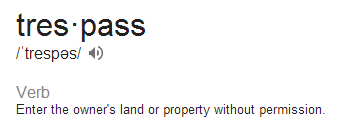
    Every dictionary has a definition of trespass.  Here is what I got when I googled “define trespass”:

    definition of trespass

    A strata corporation who enters a strata lot without consent is clearly trespassing by that definition.  Mary MacGregor’s article on the tort of trespass to land provides a good idea of how tort law might apply to a strata corporation entering a strata lot without consent.  Her summary of what constitutes trespass is consistent with the dictionary definition.  In other words, it seems a strata corporation that enters a strata lot without consent commits a tort of trespass to land against the occupant.

    Perhaps the most noteworthy part of Ms. MacGregor’s article is that courts can award punitive and exemplary damages.  This is important because physical damages are unlikely to be caused by a strata corporation unlawfully entering a strata lot.  Therefore, compensatory damages alone are an unlikely deterrent to trespass.  It is probably for this reason that courts can award compensatory and exemplary damages:

    Where the defendant’s actions were fraudulent, willful or so wholly disrespectful of the property owner’s rights as to be an affront to the reasonable person, the court can award punitive damages. The cases talk about “wanton and defiant conduct and insults”, “action going beyond inadvertence, mistake, oversight, or misunderstanding”, “arrogance and unconcern”, “acting callously”. Punitive damages can be significant compared with the usual amount of damages available in a case of trespass.

    Nominal damages could be as little as one dollar. Compensatory damages will reflect the actual loss in value of the land as proved by the plaintiff. Punitive damages can be $1,000; $5,000 or in one case $25,000—a figure that in the mind of the judge is a sufficient punishment for the callousness of the trespasser.

    This reminds me of the background to Ward v. The Owners, Strata Plan VIS #6115 (see paragraph [12]).  In that case, the strata corporation’s property manager and a locksmith actually began to force entry of a strata lot despite the protests of the occupant.  If that’s not “action going beyond inadvertence, mistake, oversight, or misunderstanding”, “arrogance and unconcern”, and “acting callously”, I don’t know what is.  Sadly we didn’t get an on-point ruling about that incident, though, probably because the occupant ultimately granted consent before entry was successfully forced.

    Privacy Tort

    The BC Law Institute’s privacy act report describes in some detail how the Privacy Act creates a statutory tort of breach of privacy.  According to Getejanc v. Brentwood College a basic test to determine whether privacy violation has taken place is as follows:

    1. Was the plaintiff entitled to privacy?
    2. If the plaintiff was entitled to privacy, did the defendant breach the plaintiff’s privacy?

    We are talking about a strata corporation entering strata lots that are most often the occupants’ homes.  In Milner v Manufacturers Life Insurance Company Justice T.J. Melnick wrote

    …a person’s expectation of privacy would be highest in one’s home.

    and in Brentwood Justice J.L. Dorgan wrote

    A person’s entitlement to privacy is highest where the expectation of privacy would be greatest

    So the answer to question (1) is clearly yes.  The answer to question (2) is perhaps a bit more tempered for the case where a strata corporation enters a strata lot without consent.  The strata corporation indeed would be committing the dictionary definition of trespass in the very place where a person has the highest entitlement to and expectation of privacy.  Therefore it would seem academic that a breach of privacy would result.  However, section 1(3) of the Trespass Act requires the following of a court:

    In determining whether the act or conduct of a person is a violation of another’s privacy, regard must be given to the nature, incidence and occasion of the act or conduct and to any domestic or other relationship between the parties.

    A typical scenario we are considering is the strata corporation entering a strata lot without consent for purposes of inspection, maintenance, repair, or during an emergency.  Does the relationship between the strata corporation and the owner provide legal justification to enter a strata lot without consent?  Does the apparent good faith purpose of repair and maintenance provide that legal justification?  Those questions, it seems, remain unanswered by the courts.

    Criminal Code

    Section 349 is the section of the Criminal Code that perhaps most likely applies to the entrance of a strata lot by a strata corporation without consent:

    349 (1) Every person who, without lawful excuse, the proof of which lies on that person, enters or is in a dwelling-house with intent to commit an indictable offence in it is guilty of an indictable offence and liable to imprisonment for a term not exceeding ten years or of an offence punishable on summary conviction.

    (2) For the purposes of proceedings under this section, evidence that an accused, without lawful excuse, entered or was in a dwelling-house is, in the absence of any evidence to the contrary, proof that he entered or was in the dwelling-house with intent to commit an indictable offence therein.

    In the case where a representative of a strata corporation enters a strata lot without consent, dispute that the strata lot was entered is unlikely.  What should be of grave concern to the representative entering a strata lot, then, is that 349(2) shifts the burden of proof to the accused.  To avoid conviction, they must either have evidence of either a “lawful excuse” for their presence in the strata lot or evidence that they did not intend to commit an indictable offence.

    It seems unlikely that a representative of a strata corporation who enters a strata lot without consent would have criminal charges brought against them.  However, given the severity of the punishment (up to 10 years in prison) and the collateral consequences of having a criminal record, this possibility should be a consideration by anyone entering a strata lot without consent.

    Special Case: Charter of Rights and Freedoms

    Strata corporations have popularly been called the “fourth” level of government.  After all, lawful operation of a strata plan involves many trappings of government including democratic elections, annual budgets, record-keeping, and bylaw enforcement.  If a strata corporation is indeed a level of government, then the Charter of Rights and Freedoms should protect a resident in his or her relationship with the strata corporation.  Accordingly, then, if an occupant of a strata lot is suspected of violating a bylaw (and perhaps any law), the occupant should be afforded the same protection against unlawful search and seizure by a strata corporation as they are by any other level of government.

    So it seems then, if a strata corporation enters a strata lot to inspect or search for a suspected bylaw violation, such entry may well be prohibited by the Charter of Rights and Freedoms.