Entry by BC strata corporations into strata lots is a recurring discussion I seem to be drawn into. People acting on behalf of strata corporations (usually council members, caretakers, and property managers) often seem to believe that they are somehow exempt from laws protecting residents from trespass, invasions of privacy, and break and enter. I have personally heard numerous credible stories of entry without consent in buildings where I lived. There has also been at least one admission by a licensed strata property manager made before our courts that forcing entry is “common practice” (see [52] in Ward).
Without consent, a strata corporation has no explicit right to enter a strata lot even in an emergency1. The Strata Property Act bestows no special immunity from prosecution or lawsuits under common law, the Criminal Code of Canada or the Trespass and Privacy Acts. Accordingly, anyone entering a strata lot without consent under the mere authority of a strata corporation, may well be doing so unlawfully and risks court-ordered damages, fines, and imprisonment.
As we will see in Part II of this series, the Strata Property Act may possibly grant a strata corporation implicit rights to enter a strata lot without consent in some circumstances.
I will be using words like “seems”, “might”, “likely”, and “probably” throughout this series. There are many aspects of strata living where either lawmakers or judges have made clear what is lawful. Unfortunately, it seems that the matter of a strata corporation entering a strata lot without consent is not an aspect that benefits from such clarity. There are no statutes that directly address entry without consent, and it seems that the closest case law speaks only tangentially to the matter. So until a judge or a legislature makes new law that speaks directly to the prospect of entry without consent, the best anyone faced with that prospect can do is try to examine the laws that do exist.
Part I of this series is a roundup of the laws against entry without consent. Part II looks at how the Strata Property Act applies and how it might permit entry without consent. In part III (if I get that far) I hope to propose bylaw amendments that any strata corporation can use to clarify within their own strata plan the conditions when entry without consent is permitted.
Laws Against Entry without Consent
In general, a person who enters someone else’s home might be doing nothing wrong in one case but might be committing a crime in another case. It should come as no surprise that the laws of BC and Canada regard a friend whom you invite into your home differently from a stranger who breaks into your home and steals your TV. A strata corporation entering a strata lot without consent probably falls somewhere on that spectrum. There are four obvious ways that the law might protect a strata lot from entry without consent by the strata corporation: Trespass act, trespass tort, privacy act, and criminal code. There seems also to be a special case where the Charter of Rights and Freedoms might provide protection against entry.
The Trespass Act
Section 4 of the Trespass Act sets out what constitutes a trespass offence. That section covers a number of different trespass scenarios. The most relevant one is this: If the occupant of a strata lot notifies a person that they are not permitted to enter the strata lot, then that person commits an offence if they enter the strata lot. Notice could be oral, in writing, or by posting signs. Without such notice, it seems that someone entering a strata lot without consent does not commit a Trespass Act offence. Accordingly, an owner who wishes to prohibit the strata corporation from entering their strata lot should send written notice to that effect to the strata corporation.
Under the Trespass Act, there are two notable defenses available to a person entering a strata lot without consent: They entered the strata lot under either ‘colour of right’ or ‘lawful authority’. Whether a strata corporation could successfully mount such defenses seems to be an open question. I was not able to find any case law on this point.
Anyone who is acting on behalf of the strata corporation should note that an offence under the Trespass Act is punishable by a fine of up to $2000 and up to 6 months in prison.
Trespass Tort
Every dictionary has a definition of trespass. Here is what I got when I googled “define trespass”:
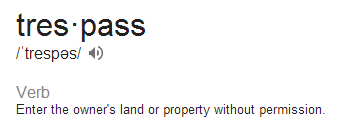
A strata corporation who enters a strata lot without consent is clearly trespassing by that definition. Mary MacGregor’s article on the tort of trespass to land provides a good idea of how tort law might apply to a strata corporation entering a strata lot without consent. Her summary of what constitutes trespass is consistent with the dictionary definition. In other words, it seems a strata corporation that enters a strata lot without consent commits a tort of trespass to land against the occupant.
Perhaps the most noteworthy part of Ms. MacGregor’s article is that courts can award punitive and exemplary damages. This is important because physical damages are unlikely to be caused by a strata corporation unlawfully entering a strata lot. Therefore, compensatory damages alone are an unlikely deterrent to trespass. It is probably for this reason that courts can award compensatory and exemplary damages:
Where the defendant’s actions were fraudulent, willful or so wholly disrespectful of the property owner’s rights as to be an affront to the reasonable person, the court can award punitive damages. The cases talk about “wanton and defiant conduct and insults”, “action going beyond inadvertence, mistake, oversight, or misunderstanding”, “arrogance and unconcern”, “acting callously”. Punitive damages can be significant compared with the usual amount of damages available in a case of trespass.
Nominal damages could be as little as one dollar. Compensatory damages will reflect the actual loss in value of the land as proved by the plaintiff. Punitive damages can be $1,000; $5,000 or in one case $25,000—a figure that in the mind of the judge is a sufficient punishment for the callousness of the trespasser.
This reminds me of the background to Ward v. The Owners, Strata Plan VIS #6115 (see paragraph [12]). In that case, the strata corporation’s property manager and a locksmith actually began to force entry of a strata lot despite the protests of the occupant. If that’s not “action going beyond inadvertence, mistake, oversight, or misunderstanding”, “arrogance and unconcern”, and “acting callously”, I don’t know what is. Sadly we didn’t get an on-point ruling about that incident, though, probably because the occupant ultimately granted consent before entry was successfully forced.
Privacy Tort
The BC Law Institute’s privacy act report describes in some detail how the Privacy Act creates a statutory tort of breach of privacy. According to Getejanc v. Brentwood College a basic test to determine whether privacy violation has taken place is as follows:
1. Was the plaintiff entitled to privacy?
2. If the plaintiff was entitled to privacy, did the defendant breach the plaintiff’s privacy?
We are talking about a strata corporation entering strata lots that are most often the occupants’ homes. In Milner v Manufacturers Life Insurance Company Justice T.J. Melnick wrote
…a person’s expectation of privacy would be highest in one’s home.
and in Brentwood Justice J.L. Dorgan wrote
A person’s entitlement to privacy is highest where the expectation of privacy would be greatest
So the answer to question (1) is clearly yes. The answer to question (2) is perhaps a bit more tempered for the case where a strata corporation enters a strata lot without consent. The strata corporation indeed would be committing the dictionary definition of trespass in the very place where a person has the highest entitlement to and expectation of privacy. Therefore it would seem academic that a breach of privacy would result. However, section 1(3) of the Trespass Act requires the following of a court:
In determining whether the act or conduct of a person is a violation of another’s privacy, regard must be given to the nature, incidence and occasion of the act or conduct and to any domestic or other relationship between the parties.
A typical scenario we are considering is the strata corporation entering a strata lot without consent for purposes of inspection, maintenance, repair, or during an emergency. Does the relationship between the strata corporation and the owner provide legal justification to enter a strata lot without consent? Does the apparent good faith purpose of repair and maintenance provide that legal justification? Those questions, it seems, remain unanswered by the courts.
Criminal Code
Section 349 is the section of the Criminal Code that perhaps most likely applies to the entrance of a strata lot by a strata corporation without consent:
349 (1) Every person who, without lawful excuse, the proof of which lies on that person, enters or is in a dwelling-house with intent to commit an indictable offence in it is guilty of an indictable offence and liable to imprisonment for a term not exceeding ten years or of an offence punishable on summary conviction.
(2) For the purposes of proceedings under this section, evidence that an accused, without lawful excuse, entered or was in a dwelling-house is, in the absence of any evidence to the contrary, proof that he entered or was in the dwelling-house with intent to commit an indictable offence therein.
In the case where a representative of a strata corporation enters a strata lot without consent, dispute that the strata lot was entered is unlikely. What should be of grave concern to the representative entering a strata lot, then, is that 349(2) shifts the burden of proof to the accused. To avoid conviction, they must either have evidence of either a “lawful excuse” for their presence in the strata lot or evidence that they did not intend to commit an indictable offence.
It seems unlikely that a representative of a strata corporation who enters a strata lot without consent would have criminal charges brought against them. However, given the severity of the punishment (up to 10 years in prison) and the collateral consequences of having a criminal record, this possibility should be a consideration by anyone entering a strata lot without consent.
Special Case: Charter of Rights and Freedoms
Strata corporations have popularly been called the “fourth” level of government. After all, lawful operation of a strata plan involves many trappings of government including democratic elections, annual budgets, record-keeping, and bylaw enforcement. If a strata corporation is indeed a level of government, then the Charter of Rights and Freedoms should protect a resident in his or her relationship with the strata corporation. Accordingly, then, if an occupant of a strata lot is suspected of violating a bylaw (and perhaps any law), the occupant should be afforded the same protection against unlawful search and seizure by a strata corporation as they are by any other level of government.
So it seems then, if a strata corporation enters a strata lot to inspect or search for a suspected bylaw violation, such entry may well be prohibited by the Charter of Rights and Freedoms.
 Admin SNAFU